


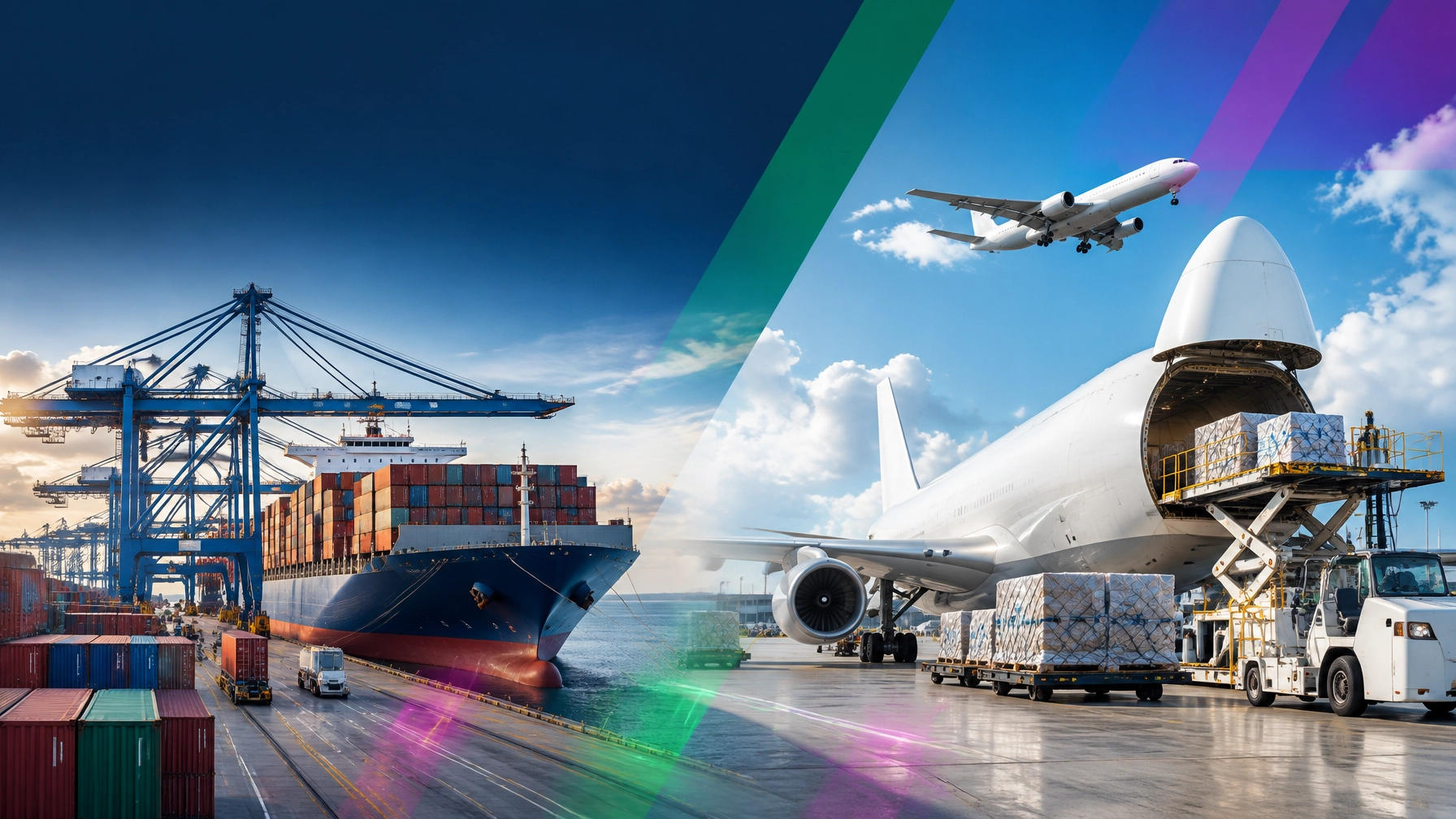

Peak season does not leave much room for late decisions.
As Q4 demand increases, available capacity can tighten, inventory becomes more time-sensitive, and a delay can affect promotions, production schedules, customer commitments, and revenue.
That makes the choice between ocean freight services and air freight shipping a strategic decision, not simply a transportation preference.
Ocean freight is generally the stronger option for high-volume, cost-sensitive cargo with a manageable planning window. Air freight is better suited to urgent, high-value, lightweight, or time-critical shipments. In many cases, the most resilient plan combines both modes.
This guide gives you a practical framework for deciding how to move peak-season cargo into Q4 2026.
Start with the business outcome, not the freight rate
Before comparing modes, define what success means for each shipment.
Ask yourself:
- When must the inventory be available for sale or production?
- What is the cost of a stock-out?
- How much inventory can you hold before peak demand?
- Is the cargo high value, perishable, regulated, oversized, or hazardous?
- Can your customer promise tolerate a variable arrival date?
- How important are carbon reduction and transport efficiency?
- Does the shipment require a single end-to-end logistics provider?
Your answer should reflect total landed cost, service risk, inventory exposure, and operational complexity, not only the transportation line item.

Ocean Freight vs Air Freight: Side-by-Side Comparison
| Decision factor | Ocean freight | Air freight |
|---|---|---|
| Transit time | Longer transit with additional port, terminal, and inland handoffs. Best when you can plan well in advance. | Shorter transit and faster replenishment, subject to flight schedules, cargo acceptance, and customs clearance. |
| Cost per kilogram or cubic meter | Usually more economical for heavy, bulky, or container-scale shipments. | Usually more expensive per kilogram or cubic meter, especially for large or dense cargo. |
| Capacity | Strong choice for high-volume, heavy, oversized, or repeat replenishment cargo. | Best for smaller consignments, urgent SKUs, and cargo with a high value-to-weight ratio. |
| Booking lead time | Requires earlier forecasting and booking, particularly during Q4 capacity pressure. | Often offers more flexibility for late replenishment, although peak-season space should still be reserved early. |
| Cargo suitability | Suitable for high volume, heavy goods, machinery, stable inventory, and many oversized shipments. | Suitable for high-value, perishable, promotional, urgent, and lightweight goods. |
| Peak-season risk | More exposed to port congestion, rolled sailings, equipment availability, and inland delays. | Less exposed to ocean-port congestion but can face constrained aircraft capacity, handling limits, and schedule changes. |
| Customs and documents | Typically involves ocean bills of lading, commercial documents, container information, and destination-port processes. | Typically involves air waybills, commercial documents, security screening, and airport customs processes. |
| Visibility | Tracking is available across booking, sailing, transshipment, discharge, and delivery milestones, though ETAs may change. | Tracking often provides more frequent movement updates across airport and flight milestones. |
| Carbon footprint | Generally more fuel-efficient for long-distance, high-volume transportation. | Typically has a higher environmental impact per unit transported. |
| Total landed cost | Lower freight cost can be offset by inventory carrying costs, safety stock, storage, or delay exposure. | Higher freight cost may be justified when it prevents stock-outs, missed launches, or expensive production interruptions. |
Transit times, rates, capacity, and documentation requirements vary by origin, destination, carrier, commodity, and service level. Your freight forwarding partner should confirm the current operating conditions for your specific lane.
Choose ocean freight when scale and cost control matter most
Ocean freight should usually be your first consideration when your shipment has the following characteristics:
- You are moving container-scale or high-volume cargo.
- The products are heavy, dense, or expensive to move by air.
- Demand is predictable enough to support advance planning.
- Your delivery window allows for longer international transit.
- The cargo is not dependent on an immediate launch or replenishment.
- You need to reduce freight cost per unit.
- Your business has carbon-reduction objectives.
- You can position safety stock or use regional warehousing.
Ocean freight services are particularly effective for base inventory, seasonal goods ordered in advance, furniture, machinery, packaged products, durable consumer goods, and repeat replenishment programs.
However, selecting ocean freight does not remove the need for active management. You still need to confirm booking cutoffs, container availability, documentation accuracy, port conditions, customs requirements, delivery appointments, and inland transportation.
A well-planned ocean shipment can protect margins. A late or poorly documented shipment can create storage charges, demurrage, missed sales windows, and avoidable operational pressure.
Choose air freight when speed protects revenue
Air freight shipping becomes more compelling when the cost of delay is greater than the premium for faster transportation.
Consider air freight when:
- The cargo is needed quickly to prevent a stock-out.
- You are replenishing a fast-selling or promotional SKU.
- The product has a high value-to-weight ratio.
- You are supporting a product launch or fixed sales event.
- The shipment is relatively small or lightweight.
- The cargo is perishable or has a limited usable life.
- A production line, customer order, or service commitment is at risk.
- An ocean shipment has been delayed and recovery is necessary.
Air is also useful when your demand signal becomes clearer late in the planning cycle. Instead of moving all forecasted inventory through a premium mode, you can use ocean freight for the planned base volume and reserve air for exceptions.
This approach helps you preserve responsiveness without allowing urgent shipments to determine the cost structure for your entire supply chain.

Match the mode to the cargo profile
The physical and commercial characteristics of your cargo should guide the decision.
Weight and volume
Ocean freight is normally better for heavy, bulky, or high-volume shipments. Air freight is most effective when the cargo occupies limited space and the value of speed is high.
Dimensional weight can materially affect air freight pricing, so assess both actual weight and volume before comparing options.
Value and inventory risk
High-value goods may justify air transportation because faster movement reduces the time capital is tied up in transit and can limit exposure to missed sales.
Lower-margin or stable-demand products are often better suited to ocean freight, particularly when you can forecast demand accurately.
Perishability and shelf life
Perishable goods, temperature-sensitive products, and items with a short selling window require careful service design. Air may reduce transit exposure, while ocean may remain appropriate for cargo with validated temperature-control processes and sufficient shelf life.
Hazardous materials
Both modes require accurate classification, packaging, labeling, declarations, and regulatory compliance. Air transport can involve more restrictive acceptance requirements for certain dangerous goods. Confirm the commodity rules before booking.
Oversized or irregular cargo
Ocean freight generally provides more flexibility for oversized, heavy, or unusual cargo, subject to vessel, container, port, and inland equipment limitations. Air freight may be constrained by aircraft door dimensions, pallet positions, weight limits, and handling infrastructure.
Manage customs and documentation before the cargo moves
A fast mode cannot compensate for incomplete paperwork.
For either mode, you should verify:
- Commercial invoice and packing list accuracy
- Product descriptions and classifications
- Country of origin
- Import permits or licenses
- Incoterms and responsibility allocation
- Customs broker instructions
- Valuation, duties, and taxes
- Special handling or regulatory requirements
Ocean shipments commonly involve container-level documentation, bills of lading, terminal processes, and destination-port coordination. Air shipments commonly rely on air waybills, airport handling procedures, security screening, and flight-specific acceptance requirements.
The practical difference is that a documentation issue can affect an ocean shipment over a longer chain of port and inland milestones, while an air shipment may face a faster but more immediate cutoff. In both cases, document review should happen before cargo is tendered.
Evaluate reliability, visibility, and total landed cost together
Reliability is not the same as speed. A fast service that misses a critical cutoff may be less useful than a slower service that is properly planned and monitored.
For each option, evaluate:
- Schedule risk: What could cause a delay on this lane?
- Visibility: Which milestones will your team receive?
- Exception management: Who will notify you and recommend alternatives?
- Inventory exposure: How much safety stock is required?
- Financial impact: What is the cost of delay, storage, markdowns, or lost sales?
- Operational fit: Can your warehouse and delivery network receive the cargo as planned?
- Sustainability: Does the selected mode align with your environmental objectives?
MOR Logistics provides integrated air, ocean, road, warehouse, and intermodal freight services so you can evaluate these factors as one connected supply chain rather than as separate transactions.
Use a hybrid strategy to balance cost and resilience
A hybrid plan can be the most effective option for Q4.
Partial air shipments
Move the majority of your forecasted inventory by ocean, then send a smaller portion by air for:
- Early launch quantities
- High-demand SKUs
- Promotional inventory
- Replacement stock
- Demand that exceeds the original forecast
Sea-air solutions
Sea-air transportation can combine an ocean leg with an air leg, providing a middle-ground option when pure air is too expensive and pure ocean is too slow. The feasibility depends on the origin, destination, transfer point, cargo profile, and available service network.
Pre-positioning inventory
Move core inventory before peak season and place it closer to the destination market through secure warehousing and distribution. This can separate international transportation timing from final customer demand.
For domestic pickups, consolidation, warehousing, and coordination before international shipment in the United States, Rule Logistics is MOR Logistics’ official partner in the USA. This support can help organize the domestic stage before cargo enters the international transportation plan.

Book earlier than your emergency plan requires
For Q4 2026, use your required delivery date to work backward through every milestone:
- Production completion
- Cargo readiness
- Origin pickup
- Consolidation or warehouse receiving
- Export documentation
- Booking cutoff
- Departure
- Port or airport handling
- Customs clearance
- Domestic delivery
- Final warehouse appointment
Book planned ocean volume as early as your forecast reasonably allows. Confirm air capacity before your shipment becomes urgent, especially for promotional or high-value cargo. Keep alternative routing and mode-shift options available for priority SKUs.
The right answer is rarely “all ocean” or “all air.” A future-proof supply chain uses ocean freight for scale, air freight for agility, and disciplined planning to determine where each mode creates the strongest business value.
MOR Logistics can help you compare ocean freight services, air freight shipping, customs requirements, warehousing, domestic transportation, and end-to-end supply chain management solutions for your Q4 requirements. Contact MOR Logistics to review your cargo profile, delivery windows, and peak-season transportation strategy.